Coast FIRE Calculator
Find Out if You Can Stop Saving for Retirement Today
Last updated: August 2026
Coast FIRE Retirement Calculator: Can You Stop Saving for Retirement Today?

Imagine not having to worry about investing anymore. Imagine that if your boss makes you mad tomorrow, you actually have the option to walk away and find something less stressful — not because you're rich, but because you've already done the hard part. That flex has a name: Coast FIRE. And it doesn't require you to retire at 35 or grind through some extreme hustle. It's a simple unlock, and once you understand the math, you can find your own number in minutes.
This isn't just theory. People are actually using this to leave stressful corporate jobs in their 40s — not to stop working forever, but to stop needing to save so aggressively, and to get their time back.
What Is Coast FIRE?
Coast FIRE (Financial Independence, Retire Early — the "coasting" version) is the point where the money you've already invested, left completely untouched with no more contributions, will grow on its own into everything you'll need by retirement age. Picture coasting downhill on a bike — you've done the hard pedaling already, which was the saving part, and now momentum (compound growth) carries you the rest of the way.
Once you hit this number, you don't need to keep pouring money into retirement accounts. You just need to earn enough to cover your current lifestyle — through your regular job, a lower-stress job, part-time work, freelancing, or consulting — while your existing corpus quietly compounds in the background until you're ready to fully retire.
A Real Example: Meet Mary
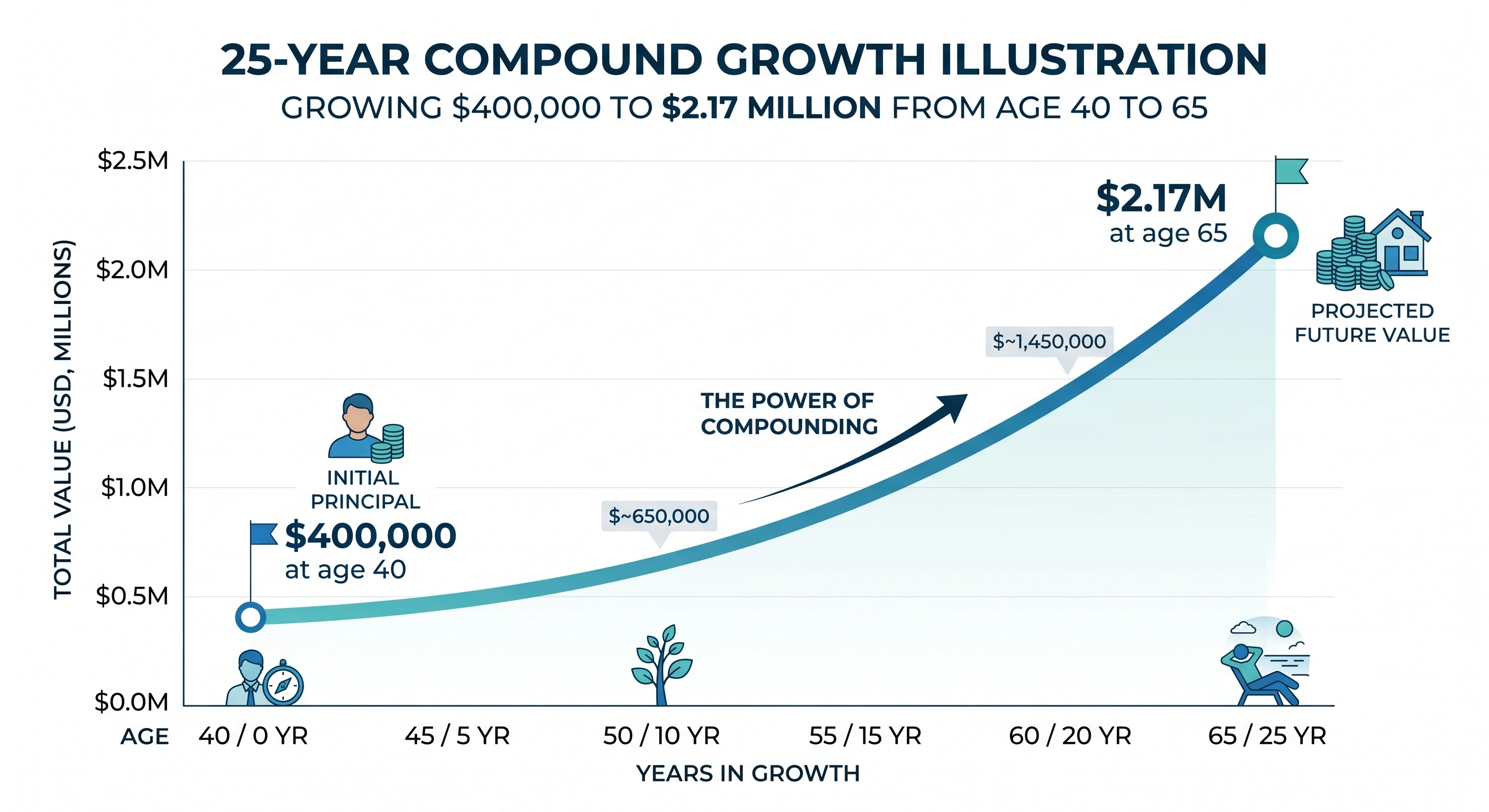
At 40 years old, Mary had $400,000 invested. Not $4 million. No inheritance. Just $400,000. And that one number meant she never had to invest another dollar toward retirement again.
Here's why: using a long-term average stock market return of 7%, that $400,000 grows on its own to just over $2.17 million by the time she turns 65. She never adds another dollar. At a 4% withdrawal rate, that's about $86,800 a year in retirement income — enough to replace 80% of a $108,000 salary. From that point forward, every dollar she earns can go somewhere else: paying off debt, traveling, or even taking a pay cut for a less stressful job. That's Coast FIRE in action.
 $400,000 invested at 40, left untouched, grows to $2.17 million by 65.
How to Use This Coast FIRE Retirement Calculator
If you're wondering how much do I need to coast fire, this free calculator answers that in seconds. It uses seven simple inputs, and everything is calculated locally in your browser — nothing you type is stored or sent anywhere:
- Current Age — Your age today.
- Target Retirement Age — When you plan to fully stop working.
- Current Investment Portfolio ($) — Everything you've already invested: 401(k), IRA, brokerage accounts, and similar. (Leave out your emergency fund and your primary home — those aren't part of this calculation.)
- Annual Expenses in Retirement ($) — What you expect to spend per year once retired.
- Safe Withdrawal Rate (%) — Usually 4%, the standard number backed by decades of portfolio research.
- Expected Investment Return (%) — Your assumed yearly return, often based on long-term stock market averages.
- Expected Inflation Rate (%) — Your assumed long-term inflation rate.
Hit Calculate, and you'll get four answers: your Target FIRE Number, your Coast FIRE Number, a clear Coast FIRE Status (Yes or No), and — if you're not there yet — your exact Shortfall. You can print, copy, or download the results to keep for later.
That plain Yes/No answer is what makes this useful instead of just another confusing spreadsheet. It tells you exactly where you stand, not just a dollar figure you have to interpret yourself.
The Coast FIRE Formula, Explained Simply
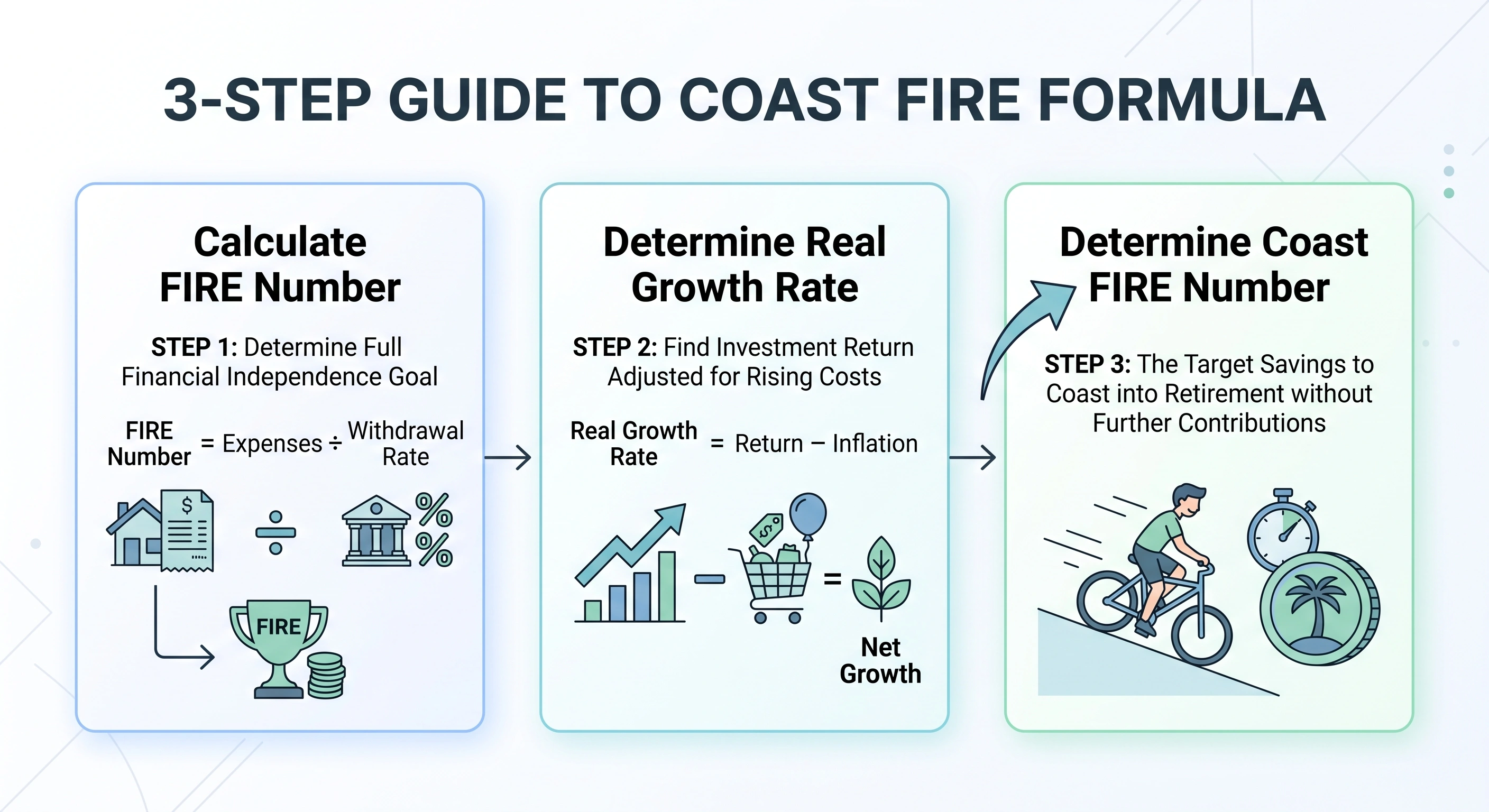
This coast fire formula runs on real rate of return math, not just raw investment growth, and it happens in three easy steps.
Step 1 — Find your FIRE Number. This is the full amount you'd need if you were retiring today. Most people aim to replace about 80% of their income in retirement, not 100% — because by the time you retire, your mortgage is often paid off, you're no longer commuting, and your kids are usually grown and independent. So take your expected annual expenses and divide by your safe withdrawal rate:
FIRE Number = Annual Expenses ÷ Safe Withdrawal Rate
Step 2 — Find your Real Growth Rate. Since this math should reflect today's dollars, subtract inflation from your expected return:
Real Growth Rate = Investment Return − Inflation Rate
Step 3 — Discount it back to today. Take your FIRE Number and work out what smaller amount, invested today, will grow into it by your retirement age:
Coast FIRE Number = FIRE Number ÷ (1 + Real Growth Rate)(Years Until Retirement)
Try It Yourself: A Quick Example
Say you're 30, planning to retire at 65, and expect to spend $40,000 a year in retirement.
- FIRE Number: $40,000 ÷ 4% = $1,000,000
- Real Growth Rate: 8% return − 2.5% inflation = 5.5%
- Years to Retirement: 65 − 30 = 35 years
- Coast FIRE Number: $1,000,000 ÷ (1.055)35 ≈ $153,500
If you already have around $153,500 invested at 30, you could stop contributing entirely, and compound growth alone should carry you to $1 million by 65. If you're below that, your coast fire shortfall shows exactly how much more you need today to catch up — and if it's zero, congratulations, you're already Coast FIRE.
What Coast FIRE Looks Like at Different Ages
Here's a rough guide to how much of your full FIRE Number you'd need invested today, based on how many years you have left until retirement (assuming a 65 retirement age and typical market returns):
| Your Age | Years Left | % of Full Number Needed Today |
|---|---|---|
| 25 | 40 years | ~5% |
| 35 | 30 years | ~14% |
| 45 | 20 years | ~33% |
| 55 | 10 years | ~66% |
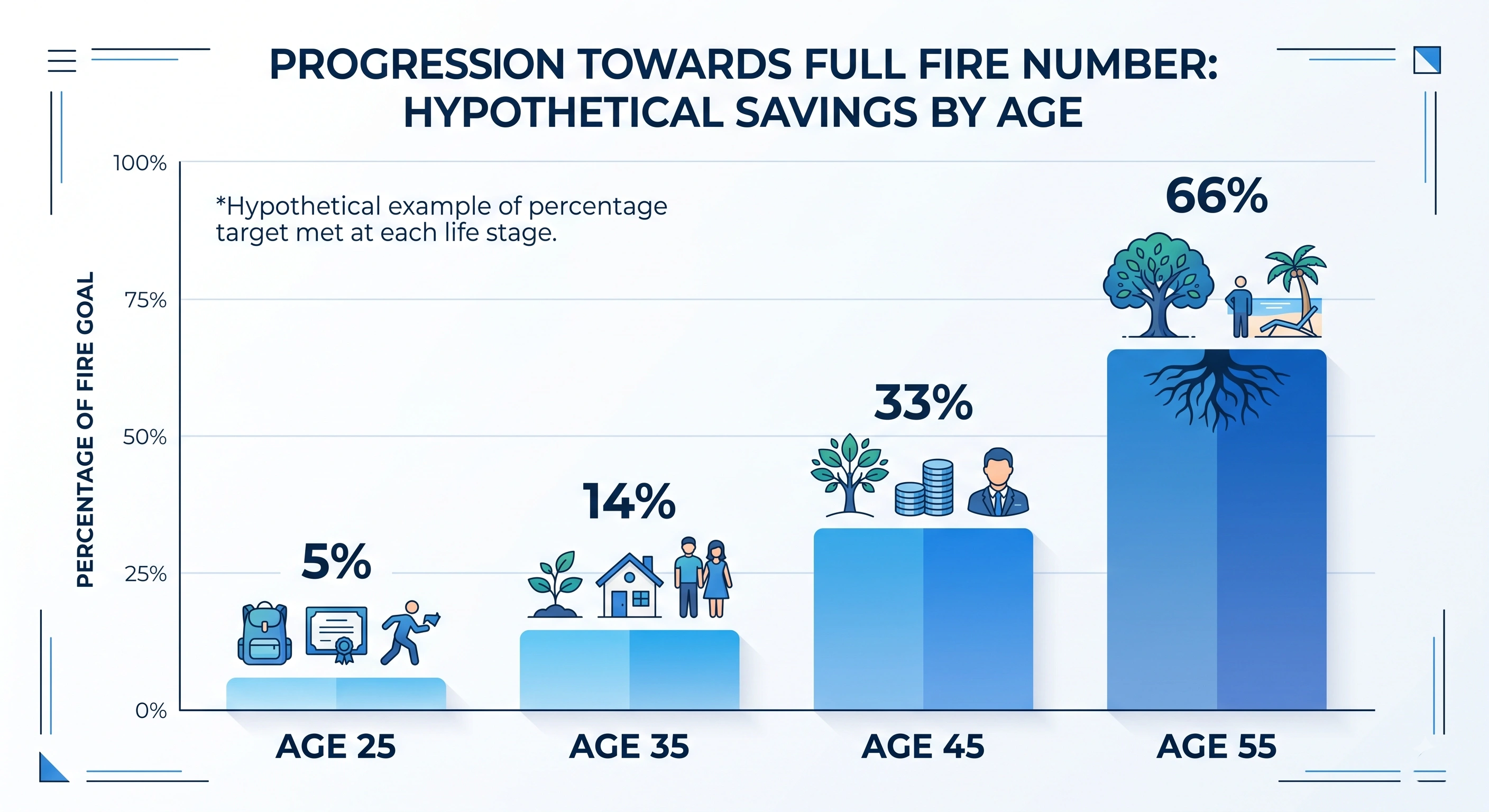 The earlier you start, the smaller your Coast FIRE number today.
Notice how much that percentage jumps between 25 and 35 — going from needing just 5% of your number to needing 14% in a single decade. That's not because your target changed much; it's because you lost ten years of compounding. Your 20s are your biggest asset, more than your salary ever will be, simply because of how much time is sitting in front of you.
Your 30s tend to be when real life shows up — a first home, a mortgage, kids, career changes. None of that is bad, but every financial decision in that decade compounds one way or the other. Interestingly, the people who hit Coast FIRE earliest usually aren't the highest earners — they're the ones whose spending didn't grow as fast as their income.
By your 50s, Coast FIRE is less about optimizing and more about clarity. There isn't much runway left, so you need to know exactly where you stand. If you're above your number, you've already coasted. If you're meaningfully below it, it's a gap you'll need a real plan to close.
A Second Way to Coast: Building an Income Bridge
There's another practical way people approach Coast FIRE, especially if they want to leave a stressful job well before their traditional retirement age. Instead of just letting your existing corpus grow untouched, you also build a second, smaller income stream — through consulting, freelancing, coaching, part-time work, or a gig — that's enough to cover your day-to-day living expenses for the next 10 to 15 years.
Here's the basic outline:
- Estimate your full retirement number — how much you'll need by the time you fully retire (say, age 60), accounting for future expenses, inflation, and your withdrawal rate.
- Add up your current invested assets — mutual funds, retirement accounts, and similar, excluding your emergency fund and your home.
- Project the future value of that corpus — let it grow untouched at a conservative, realistic return rate, with zero withdrawals.
- Redefine what "work" means for this phase. The goal isn't to maximize your earnings anymore — it's just to cover your current lifestyle while your corpus compounds quietly in the background.
- Build that income bridge — through consulting, freelancing, remote work, or part-time work, enough to sustain you without touching your investments.
Once you reach full retirement age, your investments will have compounded on their own, and you can start withdrawing safely using the 4% rule.
The honest risk here is getting your expenses wrong. Everyone's number is different depending on family responsibilities, lifestyle, and how much they actually spend versus earn. It's also worth testing your ability to earn that income bridge before you quit outright — a career break or a slow transition tends to work better than jumping straight out of a full-time job. This approach isn't formal financial advice; it's a framework worth discussing with a financial professional who understands your full picture.
Coast FIRE vs. Lean FIRE vs. Fat FIRE vs. Barista FIRE
The Barista FIRE vs Coast FIRE comparison comes up the most, since the two are easy to confuse. Coast FIRE is one of several FIRE variants:
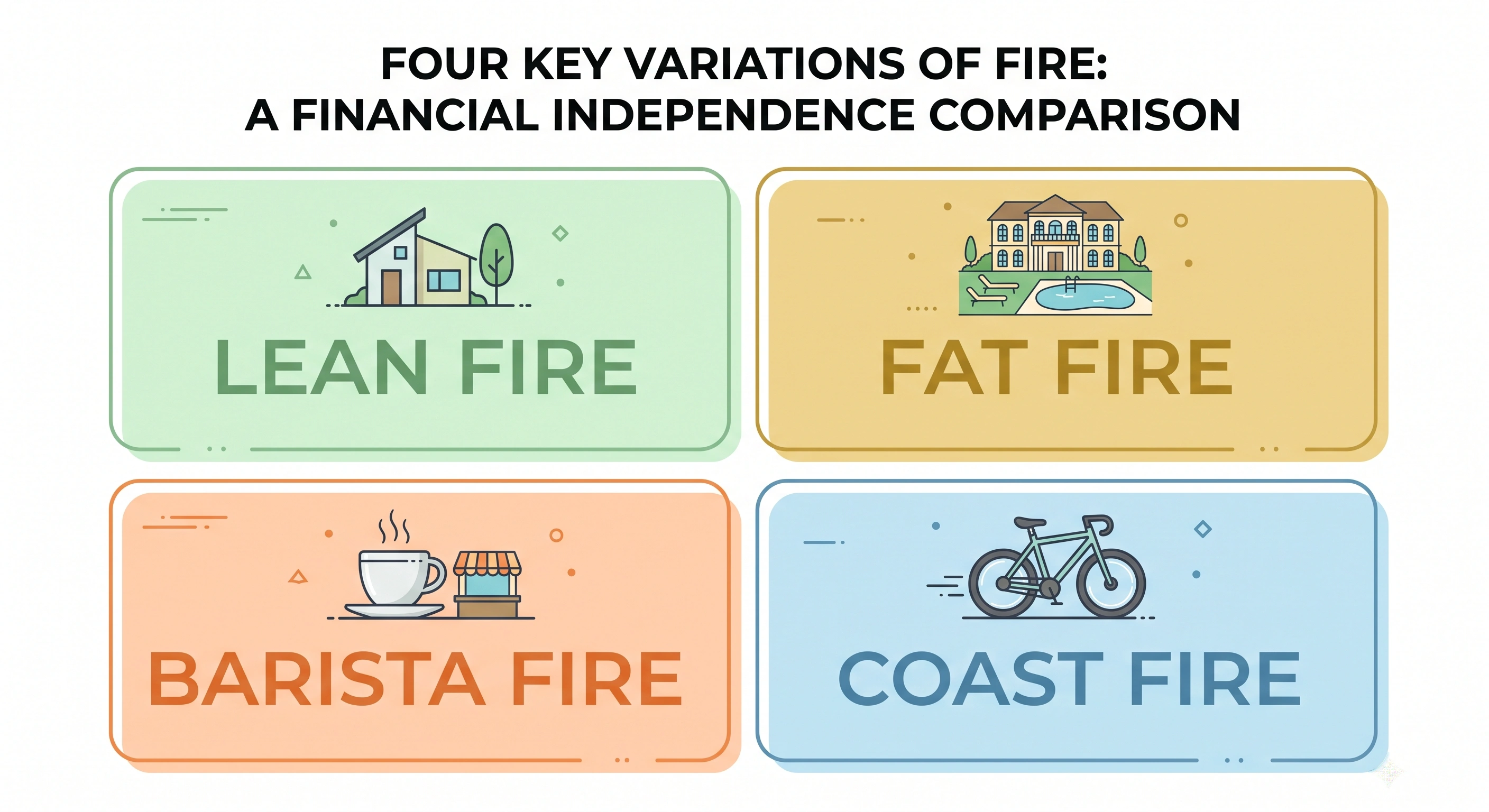
- Lean FIRE — Retiring on a minimal, tightly budgeted lifestyle.
- Fat FIRE — Retiring with a larger cushion for a more comfortable lifestyle.
- Barista FIRE — Similar to Coast FIRE, but you keep earning a modest income indefinitely (not just for a bridge period) to cover part of your expenses while your portfolio covers the rest.
- Coast FIRE — Your investments alone will hit your full number by retirement age with no further contributions, but you still need income to cover your current living costs until then.
How to Adjust Coast FIRE for Social Security or a Pension
This calculator's Annual Expenses field assumes your investments are covering 100% of your retirement spending. It doesn't automatically subtract pension or Social Security income. If you're expecting either, here's how to get an accurate coast fire calculator with pension result:
- Estimate your expected annual pension or Social Security income at retirement.
- Subtract that from your Annual Expenses in Retirement figure before entering it.
- Calculate as normal.
For example, if you expect $60,000 in annual expenses but anticipate $20,000 a year from Social Security, enter $40,000 instead. This single adjustment can lower your Coast FIRE Number significantly.
Factors That Affect Your Number
- Age and time horizon: More years until retirement means more time for compounding, which lowers your Coast FIRE Number today.
- Expected return: A higher assumed return lowers your number — but stay realistic. Long-term stock market averages hover around 6-7% after inflation.
- Inflation: Higher expected inflation raises the amount you need invested today.
- Withdrawal rate: A more conservative rate (like 3.5% instead of 4%) increases both your FIRE Number and your Coast FIRE Number.
- Annual expenses: This has the biggest impact. Lowering expected spending — or accounting for pension and Social Security — directly shrinks your target.
Fitting Coast FIRE Into Your Bigger Financial Picture
Before assuming you can ease off contributions, check your current budget with a 50/30/20 budget calculator to confirm you actually have room to redirect income. If you're carrying high-interest debt, a debt payoff calculator can help you compare snowball versus avalanche strategies — paying off expensive debt often beats the market, so it's usually worth prioritizing first. It's also worth sanity-checking your growth assumptions with a Rule of 72 calculator, since your entire Coast FIRE plan depends on that same return assumption holding up over decades.
Frequently Asked Questions
How much do I need to Coast FIRE?
It depends on your current age, target retirement age, expenses, and real return. A 30-year-old retiring at 65 with $40,000 in annual expenses and a 5.5% real return needs roughly $153,500 invested today.
Can I stop saving for retirement once I hit Coast FIRE?
You can stop contributing to retirement accounts specifically, since compound growth is projected to carry your existing portfolio to your target. You'll still need income to cover current living expenses until retirement.
Does this calculator include Social Security or pension income?
Not automatically. Subtract your expected annual pension or Social Security income from your entered expenses before calculating for an accurate result.
What's the difference between Coast FIRE and Barista FIRE?
Coast FIRE means your investments alone will reach your full number with no further contributions. Barista FIRE means you keep working part-time indefinitely to cover some expenses alongside your growing portfolio.
Is Coast FIRE risky?
The main risk is underestimating your future expenses or overestimating how easily you can earn a bridge income if you leave full-time work early. It's worth testing your income plan gradually — through a career break or side income — before making it permanent, and talking to a financial professional about your specific situation.
How much do I need to Coast FIRE at 35, 40, or 45?
It depends on your spending and expected return. Using the example of a $1,000,000 FIRE number, retirement at 65, and a 5.5% real return, you would need about $201,000 invested at 35, about $262,000 at 40, or about $343,000 at 45. Enter your own numbers above to get your personal Coast FIRE number.
What is the difference between a FIRE number and a Coast FIRE number?
Your FIRE number is the full amount you need to retire, usually your yearly expenses divided by your safe withdrawal rate (25 times expenses at 4%). Your Coast FIRE number is the smaller amount you need invested today so that compound growth alone reaches your FIRE number by retirement age. This calculator shows you both.
What return rate should I use in a Coast FIRE calculator?
Many planners use a 5% to 7% real return (after inflation) for a stock-heavy portfolio, based on long-run US market history. For a more cautious plan, run the calculator at 5% or lower. A lower rate gives a bigger Coast FIRE number, which builds in a cushion for bad market years.
Reviewed by the The Calculator Sites team for accuracy against current U.S. federal guidelines and retirement standards.